Showing posts with label Public Relations. Show all posts

Wednesday, April 30, 2014

“What’s an Ethics class, and why do I need it for PR?”


            I’ve been hearing it all semester when I explain the courses I’ve been taking: “What’s that about?”, “you’re studying public relations why would you need to know ethics?”. Its been ringing in my ears throughout this entire spring semester. Honestly at first I didn’t know why I needed it and thought I learned enough of it in previous courses.

            As long as you’re a good person, you’re not gonna get in trouble, right? Well I have learned this semester the different ways you can be a good person and still find yourself in a lawsuit, or how something can completely pop up out of no where with your company or organization and you might be the only person to blame.

            The big idea of having a course of ethics for PR students is because ethics are different everywhere. People all over have different views of what is right or what is wrong because people from varying cultures and backgrounds have morals and values that may not be recognized by everyone else. The answer is really not black and white when it comes to ethics. Some actions may be seen as unethical but may not be illegal. Some are also seen as ethical yet half of us raised from a different background don’t understand why.

            So, I’ll tell you a few of the major things I’ve taken from my ethics course this semester that may just be enough to help you in a tough situation one day.

            First things first: libel. Don’t do it, ever! It’s no fun to be in a lawsuit and seen as a person that has caused drama in the corporate or media world. If you didn’t know, libel is basically calling someone something that is false or claiming a person did something that is also false. Libel is published and seen between more than just you and the person you published it about. The main thing you can cling to if you’re being sued for libel is if the stuff you published was the TRUTH. If not, then pray no one else saw it and that person can’t prove that you’ve harmed their life and reputation in some way. Side-note: slander is the speaking version of libel and you can be sued for both.

            Now, what’s the role of a public relations professional? The PRSA code of ethics is a ‘code’ that professionals in the public relations world should follow. A list of the values we strive to uphold in the corporate world to prevent the client we represent from looking sketchy and bad.

Here’s a shortened version of the PRSA code of ethics:

·       Protect and advance the free flow of accurate and honest information

·       Foster informed decision making through open communication

·       Protect confidential and private information

·       Promote healthy and fair competition among professionals

·       Avoid conflicts of interest

·       Work to strengthen the public’s trust in the profession

One decision-making model I learned in ethics was called LEAP:

L- Learn everything you can: data, laws, policies, what raises a red flag? Who are the stakeholders?

E-Evaluate your options: when all the stakeholders agree- move to the next step

A-Access you intuition: what feels right? What does your gut say? What would the headline in this news story be? What would your mother think?

P-Put your decision into action: time to make a move, evaluate and evolve from the situation.

Some other interesting points of ethics I have learned are the different theories of ethics such as: Utilitarianism, Communitarianism, Egoism and Consequentialism to name a few. They sound like a mouthful, but they are really just a way to put certain actions taken by previous people into perspective. These are more of a possibility of why they acted that way or they are just a name to place when describing the ethical decision a person makes.

            Consequentialism: “The moral rightness of an action is determined solely by its results, or consequences”. The actions made by the person weren’t moral or immoral because it all depends on the outcome. If it results in good consequences it was a good act, if bad consequences are the end result then it was a bad act.

            Utilitarianism: This falls under consequentialism and it describes the rightness or wrongness of an action by how much it affects the greater good to more people.

            Egoism: the act is morally correct if it promotes one’s long-term self-interest; this can be for an individual, a group, or organization.

            Communitarianism: this theory says actions should be intended to a sense of community and community values. In other words it tries to do what everyone would believe is best, or moral.


So those are just a few of the theories of ethics, which there are plenty of more detailed blogs over. But these are just some of the things I learned in my ethics class that I will be taking with me to my public relations profession, I hope now I can show everyone that my ethics class wasn’t just a course that I needed to graduate. I’m hoping all I learned here can keep my future clients from being in a major crisis with no-where to turn.


Sunday, April 6, 2014

Freedom of Speech and Strategic Communications


The First Amendment states that “no law shall be made respecting an establishment of religion, or prohibiting the free exercise thereof; or abridging the freedom of speech, or of the press. Or the right of the people peaceably to assemble, and to petition the government for a redress of grievances.”

         One of the most praised amendments to our constitution would be the first. It is usually shortened to “the right to free speech”. In other words, you have the right to express yourself and your beliefs without being punished.

         This freedom is one that those in the journalism and public relations field can be thankful for. When our job is to communicate the truth and reveal the facts to the public, freedom of speech is a handy thing to have on our side.

         People have been feuding the depths of this law recently with people being fired for their speech, students being punished in school for social media, and rules being set regarding people posting opinions in public forums. Many high schools have recently made it known that any students posting inappropriately on social media can be punished at school, even if the post has nothing to do with the school.

         Some workplaces have fired employees for posting on social media. Many times this happens it can end in lawsuits or disputes regarding the right to free speech being taken away. The law does not protect us from being punished by privately owned companies or organizations, only the law.

         In most cases regarding freedom of speech, the only real crime you can be punished for would be the use of libel. Libel is defined as “the false and malicious publication printed for the purpose of defaming a living person”. This act is something that would be seen as freedom of speech but protects us all from having lies spread that could harm us.

         If you sue a person for libel, you must prove it with 5 things. 1. Prove the statement was false. 2. Prove the statement was about you. 3. Show how the statement has harmed you or your reputation. 4. Prove the statement was made public. 5. Prove that this person intended to harm your reputation and that they intended malice. For most cases the most important proof to have is that the statement made was actually false.

         In most of the journalism courses I have taken I learned that libel is actually hard to win a case over, which can be good or bad. If a journalist has just made the mistake of publishing a rumor they believed to be true then they don’t deserve to be sued for libel. But if the publication had been published when they knew it was false they deserve what they have coming. It is good that these requirements are here to protect those in the field of journalism and public relations and is bad because this makes it harder when you are trying to win the lawsuit as a plaintiff.

         In my career I hope I never have to deal with such a scary thought as being sued, but it is something those of us who hope to be in the profession need to be aware of and know the details just in case. As far as being fired for something I post on Facebook or Twitter? I’m not sure how much I enjoy the idea. Obviously I am majoring in something that is all about how the public sees me and those I am representing, but it’s also a scary thought knowing I could lose my job for posting my opinion on certain matters.

         I believe that everyone does have a right under the first amendment and that right should be honored, yet we all also need to remember that while we use this right, it is also your employers right to take away your privilege to represent them while you use it. My advice is to think before you act when posting on social media, and try to keep yourself objective when it comes to controversial matters and your opinion.

Friday, February 28, 2014

No Comment


No Comment

The fast track to looking guilty in PR

Having public relations (or even journalism) as a major, we all learn that the phrase “no comment” is seen as a big no-no when it comes to responding to a crisis or incident. In journalism we learn that anyone who says “no comment” usually means they have something to hide, or we learn that this response makes the public think you are guilty. But when is it okay to say this phrase or one similar to it in this profession? Sometimes there are ways around saying those words by basically saying nothing. There are other times when you can make it obvious that you really have nothing to say at the moment.

According to PR Fuel, these are some reasons this saying is taken the wrong way:

1.     People think this means you have been uninformed and caught off guard in the moment.

2.     You’re afraid to admit you made a mistake

3.     You are defensive of your wrongdoing

4.     You have no explanation or justification for the situation

5.     You feel as if you aren’t in the wrong- or are being stubborn

Some suggestions when in a predicament where you can’t report what you know I got from John Greer’s article on CBS Moneywatch. He suggests to:

1.     Not use the phrase itself.

2.     Find some different phrases that generally mean the same thing, but are more informative and don’t seem as suspicious. – phrases such as “I’m sorry but I am not able to respond at this time because of (insert vague excuse).”

3.     Stand your ground after you have answered.


Although it is your right to remain silent, a lot of people see it as a means of suspicion when there is news or a scandal breaking. Aside from saying the phrase, giving informative answers is a much better response. For example, you work for a company that sells all natural granola bars and have just been informed they are getting sued. You only know that much. What would you say? A good response at this point would to be honest and respond with something along the lines of “we have just been informed of the lawsuit and are still finding out all of the details as to the situation at hand.” Or “We are still in the process of retrieving all information regarding to the case and plan to make a statement as soon as we know as much as we can”. Responses like these can save you from looking like you are hiding something and can keep you from revealing information without having to say “no comment.”

            These responses also make your company look professional in the media because it shows that you are not ignoring the questions that are arising from the situation. Your company is taking initiative to find out everything to better inform the public, which is an admirable action.

Now, you have found out that your company is being accused of not providing the appropriate listed ingredients on your packaging for granola bars. Now that you know the situation, some answers you might be able to provide would be “we are currently handling these accusations by allowing an investigation to take place” or any answer similar to this. This shows that you now know the situation at hand and your company is cooperating with the lawsuit, showing you have nothing to hide and that you are taking action to clear up the mess.

Throughout the investigation your company should continually report and update regarding the findings. Continue to be honest and show action and responsibility to solving the problem. If you don’t report it the media is going to anyway, and you might as well beat them to it.

            In the end, it turns out the packaging was misleading and ingredients were wrong. At this time a statement should be made that shows you are taking responsibility and working to fix the problem. If it is a minor detail problem, share it with the public so that they can know it wasn’t a huge mislabels and that the granola bars produced are and always have been ‘natural’ ingredients for a healthy diet. Honesty is usually honored as well as taking responsibility for any mistakes, even if it is just minor details.

So, when your company is caught in the middle of a misunderstanding or scandal it is always ideal to steer clear of “no comment” in order to keep an honorable and respectable reputation throughout the process and within the eyes of the public.


Friday, February 21, 2014

Blogs Suck: at least we think they do

Blogs Suck: at least we think they do

The mistaken stereotype of blogs and their uselessness

by Alexandra Smith

Okay, time to confess. I hate blogs with a fiery, burning passion. I read them when I want to know this or that and one pops up with advice but that’s about it. So I have to blog for my class and I’m not going to lie I have been avoiding it because I get so mad that I am shaking when I sit and try to figure out what to write about. I honestly feel like blogs are for people to sit there and either praise or complain. THEN I was looking up “why do blogs exist” out of anger, and what do you know someone had blogged about this topic… (eyes rolling).

Anyways, I have come to learn that blogs are actually useful in our current world of technology and social media. So tonight my blog is going to be about why they exist and hopefully if you’re like me you can get a better understanding of them.

First of all: Who are you thinking you have a place to be telling me anything on the internet? Are you a doctor or specialist? Are you a professional? Then what do you honestly think you are doing on the web giving advice? Here was my first mistake. I thought this at first and sometimes I still do. The truth is blogs might be more trustworthy than websites at times. Instead of getting information from someone who is trying to sell you a service or product, you are getting firsthand information from someone who really is just sharing their knowledge.

Want to get a wine stain out of carpet? If you looked it up there might be comments on different websites of what brand of cleaner to use. If you find it on a blog, someone may have a cheap and easy way to get the stain out who has shared their stain-removing concoction and instructions of how to make it. The same thing can apply for any kind of information you might be looking for online.

Another misconception of blogs is the idea that they are like a journal for the person who is the author of a blog. It isn’t a place for people to complain about their personal lives- unless it’s the blog of someone famous and people actually want to listen to it. Blogs are used most often these days for companies, products, organizations, or by people who are considered experts on topics in which people read their blogs to listen to their advice or opinion. Companies these days can send sample products to someone in charge of a blog for them to write a review of their product. Some organizations blog just to keep people updated on their latest developments or events. There is often ethical questions from having people blog about products they have received from companies and why it may be considered bribery for a good review, but it still happens.

The next wrong idea I had about blogs was that it was meant for either praise or complaints. This can be true because people can blog about whatever they want. People can even blog about how much they truly hated your product or service. When this happens, you can comment or contact the blogger to see if there is a way to fix the situation. The fact is, it can seem to be about complaining or praising but a lot of blogs are simply informational or helpful. My personal favorite for blogs is the Mockingjay.net blog which posts about any recent news regarding The Hunger Games trilogy books and movies. This is just one example of a topic that an entire blog can be about.

Last, when I was writing my blogs for my class I felt like if people saw it they would think I was just another weirdo blogger thinking they knew it all. I also thought that no one would even see my blog posts because no one would care. When I was contacted about an internship recently and the man told me he “liked the work from my blog”. I asked “really?” and then I realized people really do see the things you post on a blog. The importance of this mistake was realizing that my blog was actually another way of promoting myself and networking. Both of which are really important for an undergraduate student as well as for anyone who may be in the career world.
I’m not going to lie, I really despised blogs. But now I see that they are actually a useful tool in the public relations world. While I’m no professional on public relations or on blogs, I’m glad I got to share the common stereotype that people may have of blogs. I’ve found several other blogs similar to this one that might be more helpful to anyone still wondering “Why blogging?” make sure to visit them!
Very Official Blog- why blogs matter
Why blogs matter to small businesses

Friday, February 7, 2014

Images of Shameful Journalism


Recently, Hollywood lost a beloved star, Phillip Seymour Hoffman, known for films such as Moneyball and The Big Lebowski. On February 2, 2014 the world was informed of the actor’s death caused by an overdose of heroin. News stands and stations have been feeding the country the tragic details of his death all throughout this week. What I don’t understand is when is it enough information for the public to be happy and just move on from it? Do we have to label him an “addict” and a drug abuser while his family is not even a week in to mourning their loss of a loved one?

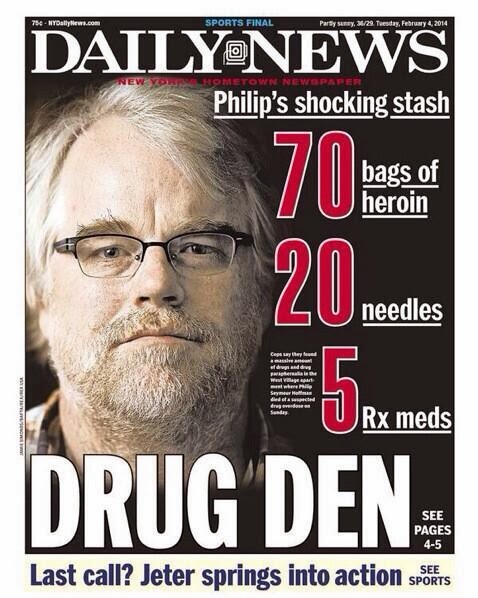
            Above is a post that was recently shared and showed up on Facebook. I’m posting it because I think the world could use a little more of the humility shown by the young woman that wrote it. Nothing angers me more than how bad journalism can make itself out to be. When you hold so much power and persuasion how can a company such as New York Daily News create a cover such as this:


            This was released Thursday, February 4 as an invite for readers to look at the details of Philip Seymour Hoffman’s death. Does anyone up at NYDaily care about the image of its magazine? Is anyone else offended by the lack of sensitivity shown by this publisher? Perhaps some tips in common decency would be in order for the ‘professionals’ that approved of such a headline.
            If I were on the public relations team for NYDaily I would obviously have a pretty big mess to clean up. When something like this happens is when PR professionals should jump in and say “hey let’s not make ourselves look bad” instead of trying to sell magazines in such a manner. I would recommend an immediate apology along with a new front page advertised in a more decent way. The whole black background and red bold letters make it seem like the cover to a dramatic and dark film, which works for the story as long as more humility is shown with the facts. And the title "Drug Den" needs to go. This example is obviously just one of the more recent incidents in which journalism has made itself look like reporters and newspapers are heartless. Not saying they are, but a majority of people think this. And who can blame them?
            Let’s not forget the many times that front-page spreads have been regarding the messy details of a failed marriage. I get it. It’s news. I guess this is how public relations professionals and journalists are different. We’re trying to keep it clean and classy while reporters apparently don’t care.
            The story is completely different when a public figure does the damage all themselves. I’m wondering what the agents for Texas country singer, Josh Abbott, are currently thinking after he openly admitted to cheating on his wife as well as addictions on his own Twitter account.


            Yikes. I’m not sure whether to applaud the man for his honesty or feel bad for his manager and those who have worked so hard for the image they have helped him create. If I were in charge of his public image, I would recommend him lay low for a while until it all blows over. Maybe somehow make the public sympathize for him, since I’m sure there is explanation for his behavior. I’m sure his fans will remain loyal since this isn’t breaking through the news and is coming from his own mouth. In public relations, I think forgiveness and empathy is something that not many people can give, but it’s what a lot of us in the industry might someday have to work toward for our client’s sake. 

Friday, January 17, 2014

David O. Russell apology for slavery comment


David O. Russell apology for slavery comment


            The title sounds worse than it may be, but a week ago the news was out about David O. Russell making a comment about Jennifer Lawrence and her film schedule for The Hunger Games franchise. Not such a friendly comment to be making in the industry right now, in my opinion.  Russell recently worked with Lawrence on Silver Linings Playbook and American Hustle. In an interview last Friday with New York Daily News he made the comments of his opinion that Lawrence is hardworking but deserves a break from her Hunger Games schedule. With quotes such as “talk about 12 years a slave” and comparing the franchise to a “hamster wheel” that is “printing money”. Here is the link to the article from New York Daily News about the apology for his interview comments with them.  NY Daily News- Apology

Ouch. In the interview Russell also stated that he knew he was going to get in trouble for his comments. Can I just say “DUH” on that one? He is entitled to that opinion and it was a question which he answered honestly. These days hurting someone’s feelings or voicing your opinion is said to be applauded, but we all know it’s basically a sin to voice any opinion that might hurt someone or a group of people. (I don’t mean to go on a rant about how annoying the spineless trophy generation is to me, that’s all I’ll say).

            So, the next step after an interview like this gets out in the media making Russell look like a tyrant is when public relations really comes in handy. Someone help him! And they did. Whether he decided to apologize on his own or the idea was put in his head to publicly revoke the comments, he came out Tuesday to take back what was said. If I were representing him I would have done the same thing and suggested an apology. I feel it was a pretty great PR move to make the apology public before an entire week went by and it looked too obvious that it was suggested after it might have offended someone. I couldn’t find out if Russell has a personal Twitter account, but if he had one I’m sure a tweet would be out with another apology from him personally.

            For those of you who may not know, 12 Years A Slave is a recent film nominated for a Golden Globe that has accrued a lot of publicity and praise for its portrayal of slavery. Russell’s interview was the Friday before the Golden Globes.
Here's some more links where I got info on the interview and apology. Some great points made in the stories are the Twitter users' responses to Russell's comments.

Welcome to my blog!


Nothing excites me more than the entertainment industry; specifically with actors, movies, and novels worth making a buzz. A blog and several posts are required for two of my capstone classes as a public relations student at the University of North Texas. So, sometimes my posts will have to do with assignments regarding PR and other times I plan to use this for media and entertainment purposes on my own. I’m very excited to get started! Go follow me on Twitter @alixdsmith if you like. I usually will retweet interesting news in the entertainment world as well as plenty of random tweets I might find entertaining.

To start off, my name is Alexandra and I usually go by Alex. I  am a member of PanHellenic at my University and my favorite things are books and movies. I also really enjoy fitness and jogging. I’m currently going through physical therapy so I may or may not post about my excitement for recovery. Enjoy!
 
Twitter: @alixdsmith
Instagram: alixdsmith